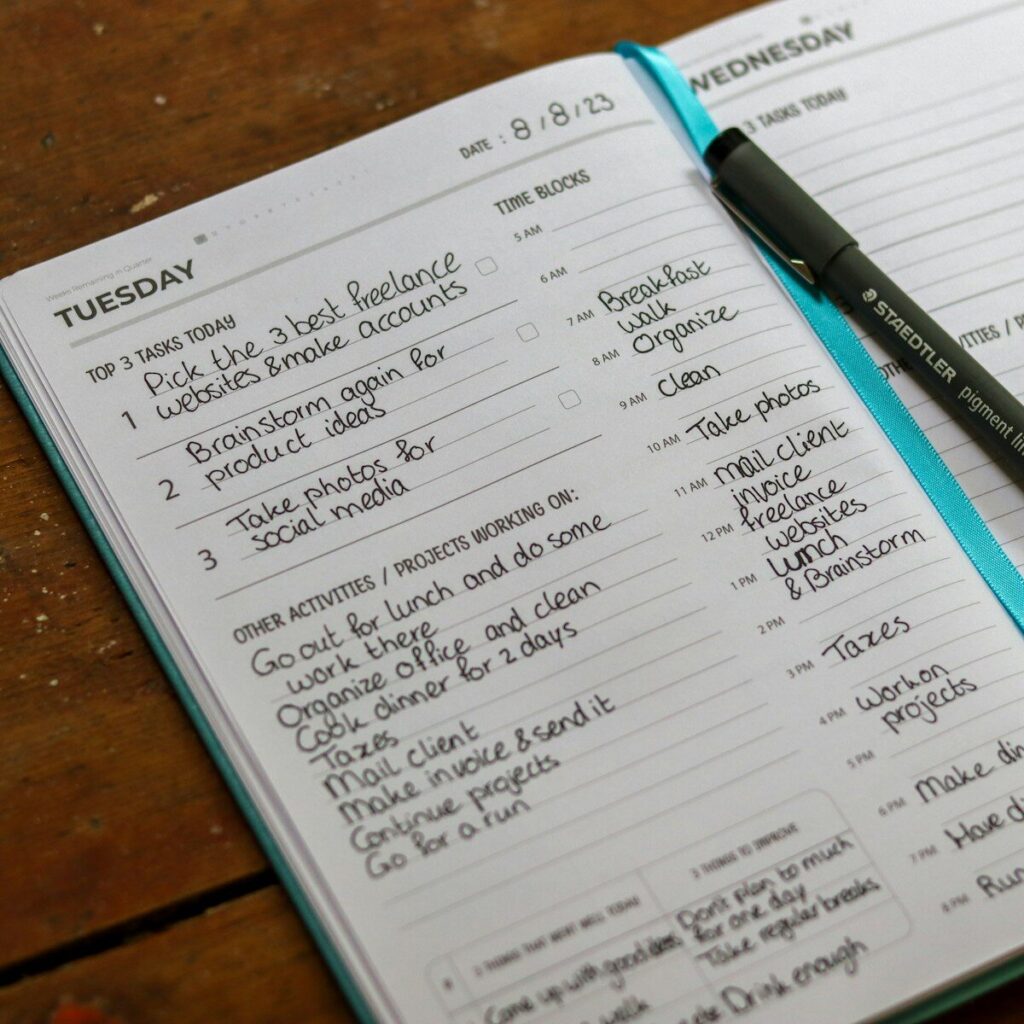
There is a particular kind of chaos that shows up when you decide to build several things at once and run out of runway before any of them are finished. Time blocking for entrepreneurs exists to prevent exactly that chaos, and yet it is one of the first habits to disappear the moment a deadline starts pressing in. The instinct under pressure is to work on everything simultaneously. The actual solution is almost always the opposite: decide in advance what gets dedicated time, and protect that time from everything else trying to compete for it.
Here is what that looks like when it goes wrong. Andrea decided to run a live launch for a new offer. She had the dates set and a rough outline of the content. She did not have a landing page, a registration system, an email sequence, a sales page, or a checkout process. She gave herself four weeks to build all of it while also creating the launch content, running the launch itself, and delivering her existing client work. Nothing was blocked off. Everything was happening at once, in whatever order felt most urgent on a given day.
What Time Blocking for Entrepreneurs Actually Prevents
A launch like that requires a minimum of six to eight interconnected pieces built across multiple platforms, under time pressure, by someone who has never built most of them before. Without dedicated blocks of time assigned to each piece, every day becomes a negotiation about what gets attention, and the things that feel most urgent in the moment, usually client delivery or “whatever fire just appeared”, win out over the things that actually need to get built before the launch date arrives.
Time blocking is not about cramming more into a day. It is about deciding, before the chaos starts, which hours belong to which piece of work, so the decision does not have to be re-made under pressure every single day. When the landing page has a block, the email sequence has a block, and the checkout setup has a block, each piece gets dedicated, uninterrupted attention instead of competing for leftover minutes between everything else.
Why Parallel Effort Without Blocks Fails
The instinct to work on everything at once feels efficient in the moment. It rarely is. Switching between unrelated tasks carries a real cost: every time attention moves from the email sequence to the landing page to the checkout flow, there is a re-orientation tax, a few minutes spent remembering where you left off and what the next step actually was. Multiply that across a day of constant switching, and a meaningful portion of available time disappears into transitions rather than progress.
This connects directly to time management — because the underlying problem in both cases is the same. Time does not disappear because there is not enough of it. It disappears because it is being spent in fragments, without protection, across too many competing demands at once.
What Blocking Time Actually Looks Like
Time blocking does not require a complicated system. It requires deciding, before the week begins, which days or hours belong to which piece of work, and treating that block as fixed rather than flexible. If Tuesday morning is blocked for the email sequence, client questions and social media and everything else wait until the block is finished. The block is not a suggestion. It is the only thing that happens during that window.
This matters most under exactly the kind of pressure that makes blocking feel impossible to maintain. When a deadline is close, the temptation to abandon the blocks and react to whatever feels urgent is strongest. That is also precisely the moment blocking matters most, because without it, the four weeks dissolve into constant context switching and nothing gets fully finished until the very end, under maximum stress.
My first launch felt like building a plane while flying it. I had the content but nothing to hold it together technically. Every piece was on a different platform and nothing talked to each other. I promised myself that if I ever did it again, I would build the system first. That is exactly what I did the second time.
The second time, the difference was not more hours. It was the same hours, deliberately allocated in advance, rather than spent reacting to whatever felt most urgent in the moment.
Letting Systems Hold the Blocks That Repeat
One of the most effective ways to protect time blocks is to remove tasks from the available pool entirely, rather than relying on willpower to defend the block every single week. When the registration page, the confirmation email, and the follow-up sequence are already built inside a connected system, they do not need a dedicated block every time you run a launch. The system runs them. The only blocks that remain are the ones that genuinely require your judgment: the content itself, and the strategic decisions around it.
This is the real value of building once and reusing rather than rebuilding every time a similar project comes around. The first launch costs the most time because everything has to be built from scratch. Every launch after that costs less, because the system already holds the pieces that do not change, and your time blocks can be reserved for the parts that genuinely need a person making decisions. That is the same principle behind task prioritization — deciding in advance what requires your judgment, so everything else can be handled by the system.
Protect the time. Decide what it is for before the day starts negotiating with you about it. That is the entire practice, and it works whether the deadline is gentle or not.
Stop Building Everything at Once, Under Pressure
If your launches and projects always seem to come down to the wire because everything happens in parallel with no protected time, the free Business Systems Assessment will show you exactly which pieces can be built once and reused, freeing up your time blocks for the work that actually needs you.
In your corner,